

Epoxy Flake Garage Floor Installation Instructions
Your complete weekend, step-by-step DIY system! The exact sequence to get professional results without spending a fortune, messy grinding or a hiring contractor.
Read Thoroughly Before Starting

The SkipGrind No-Grind Concrete Primer is the revolutionary groundwork that sets the stage for total WiseBond Floors epoxy success. This high-performance bonding primer eliminates the need for mechanical grinding while delivering powerful adhesion to properly prepared concrete.
Build the Proper Foundation for a Durable Concrete Garage Floor
When applied correctly, SkipGrind penetrates deep into the surface, creating a rock-solid bond that drives the strength, longevity, and professional-grade finish of your entire epoxy floor system.
These application instructions are specifically designed for our weekend system to help you create a professional-grade epoxy flake garage floor. While individual product label instructions may vary slightly, these directions are customized specifically for the combined products included in your kit and intended application process.
Two-Person Application for Maximum Efficiency
Mixing and applying an epoxy garage flake coating system is most efficient with at least two people. One person focuses on accurately mixing and pouring the epoxy onto the concrete, while the second immediately spreads the material for consistent coverage. Once the pour is complete, both can work together to evenly distribute the coating and maintain a smooth, uniform application.
Spiked shoes: During application of the primer, epoxy base-coat, and flake broadcasting, spiked shoes let you walk on the wet surface without leaving footprints or damaging the cure.
Avoid application on extremely cold or hot days or during wet, foggy weather. Apply with ambient and surface temperatures above 50°F (10°C) and below 90°F (32°C), and that will remain within range for at least 12 hours after application.
Safety & Surface Checks
Adhesion test: To check whether your concrete can accept an epoxy coating, drip a drop of water onto it in multiple areas. If the water absorbs into the concrete, so will our SkipGrind no-grind primer.
Ventilation: Open the garage doors fully for proper air movement. Only after application should the door be closed, and even then, leave a 6–8 inch gap for air circulation during dry and cure time.
Proper PPE: Gloves, eye protection, and appropriate respiratory protection must be worn at all times during mixing and application.
What Are Expansion Control Joints?
Typically, most concrete garage floors will have expansion control joints. When present, these joints (cuts) often appear as a large plus sign (+) pattern that divides the garage floor into multiple sections. These joint cuts may be V-shaped grooves approximately 3/8” wide formed during the initial concrete pour, or more commonly, saw-cut joints about 3/16” wide and up to 1” deep created 18–24 hours after the concrete has partially cured.
Six Phases to a Showroom Floor
The full install breaks into six phases. The detailed, numbered step-by-step is just below.
-
 Phase 01 — Prep
Clean, Degrease & Etch Floor
-
 Phase 02 — Prime
Apply SkipGrind Primer
-
 Phase 03 — Base
Apply WiseFlake Epoxy
-
 Phase 04 — Broadcast
Broadcast Multicolor Flake Chips
-
 Phase 05 — Scrape
Scrape & Vacuum Excess Flakes
-
 Phase 06 — Seal
Apply Polyaspartic Clear Coat

Installation Estimated Timeline
This installation timeline is provided as a general guideline to help plan and organize your epoxy floor installation. Actual days, start times, and project duration may vary based on your schedule, working pace, temperature, and site conditions.
| Stage | Working Time | Task / Description | Cure / Wait |
|---|---|---|---|
| Day 1 Preparation | Before Application | Empty Garage; Grind & Fix/Fill Cracks; Sweep, Vacuum, Clean & Etch; 1st masking of walls & around unmovable objects. |
— |
| Day 1 | 1 Hour | Mix & apply SkipGrind Concrete Primer on a damp (not wet) floor after cleaning. Do not fully close garage door. |
18 Hours |
| Day 2 After SkipGrind Cure |
1 Hour | Apply epoxy base & 1/4" flakes. Do not fully close garage door. |
6–8 Hours |
| Day 2 After Flake Cure | 1 Hour | Scrape and vacuum excess epoxy flakes from floor. |
N/A |
| Day 2 Later or Day 3 Morning |
1 Hour | Apply polyaspartic clear top coat. Do not fully close garage door. |
10 Hours (light walking) |
| Recovery After Day 3 | N/A | Return of contents / no vehicle traffic. (After full 24-hour cure.) |
24 Hours (do not slide objects) |
| Return to Service | N/A | Safe for driving / vehicle traffic. After a full cure totaling 72 hours for vehicles. |
48 Hours |

Detailed Installation Instructions
PURCHASE TOOLS: All application tools can be purchased easily on our site and they will ship with your DIY epoxy kit.
Tools & Materials You'll Need
- Chemical-Resistant Rubber Gloves
- Respiratory Protection (Dust Mask)
- Eye Protection
- Protective Clothing
- Safety Footwear
- Electric or Cordless Hand Drill
- Mixing Blades / Paddle (Jiffy Mixer)
- Spiked Shoes
- Tarp, Cardboard, or Drop Cloth (10’x10’)
- Small Mixing Work Table
- Blue Masking / Painters Tape
- Disposable Paint Brushes
- 5-Gallon Buckets
- Paint Roller Frames
- Angle Grinder & Concrete Blade
- Putty Knife 3-4" Wide
- Plastic Watering Sprinkle Can
- Threaded Long Handle Pole(s)
- Squeegee Frame
- Squeegee Flat & Notched Blades
- 3/8” Nap Rollers / Roller Covers
- Flat Blade Floor Scraper
- Scrub Brush Broom
- Mini-roller & covers
-
Step 1: Fill Cracks, Holes & Spalling
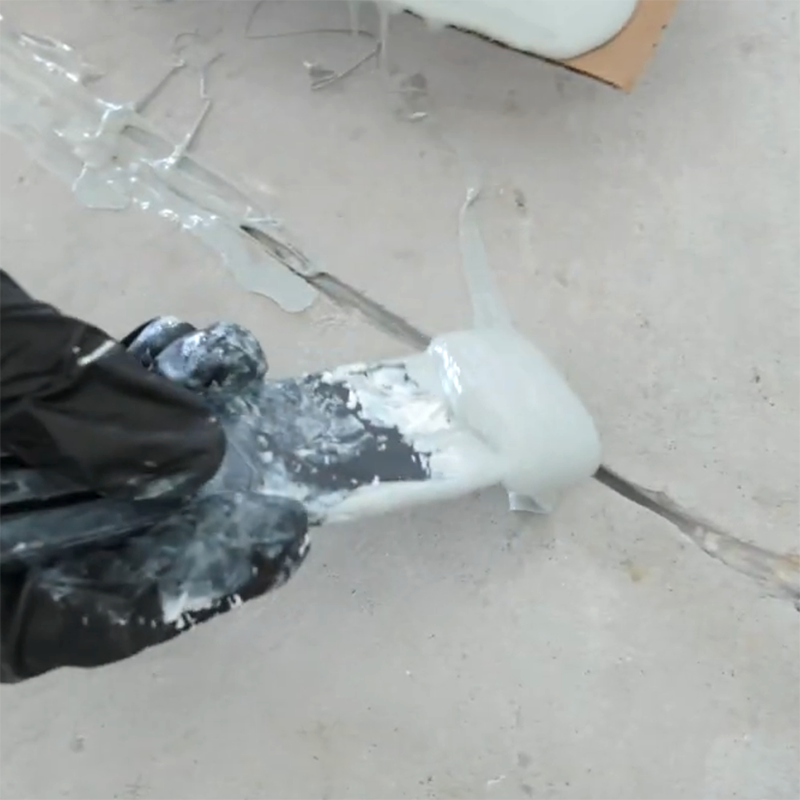
REQUIRED TOOLS: Angle grinder, 1/4" to 3/8" crack chasing blade (These can be rented at a hardware store.), putty knife, broom, shop vacuum, and proper PPE.
- Make sure to remove any loose concrete and/or foreign material. Dust and debris should be brushed and vacuumed out of crack and off surrounding areas. Fill all cracks and voids with KreteBond Concrete Crack Filler. The material cures in about 60 minutes and can then be sanded or ground smooth for a level surface.
- Voids, chips and holes must be cleaned and filled with crack filler. Hairline cracks must be routed with an 1/8" concrete cutting blade and to approx. 1/4" to 1/2" depth.
- The mix ratio of KreteBond is 1 Part-A to 1 Part-B. Using separate scooping devices, measure equal amounts from container A and container B and place material on a mixing board. Once on mixing board, mix both components with a 3-4” putty knife until a uniform color has been reached. Mix for 1-2 mins. Do not mix more material than can be applied in 2-4 minutes.
- Apply KreteBond into the crack with a 3-4” putty knife, making sure to completely fill. Push material as far into the crack as possible. Feather the KreteBond at each side of the crack to reduce telegraphing through the finish product. KreteBond may require a second coat, sanding or grinding flat and feathering the edges after it has cured. If flattening is required, it is necessary to grind the feathered edge of the KreteBond down to bare concrete. If the grinding and feathering process is not done properly, highlights may telegraph through the new coating system.
- SPALLING: Is the deterioration of a concrete surface where it cracks, flakes, or chips away, leaving pitted divots or exposed inner aggregate. To fix existing spalls, all loose and crumbling concrete must be removed with a segment cup grinding wheel down to solid concrete. The divot can then be patched or resurfaced using a high-quality concrete patch repair.
- Working time: 2-4 Mins - Do not mix more than can be applied in that window.
- Cure time: 60 minutes
-
Step 2: Clean & Etch the Concrete Floor
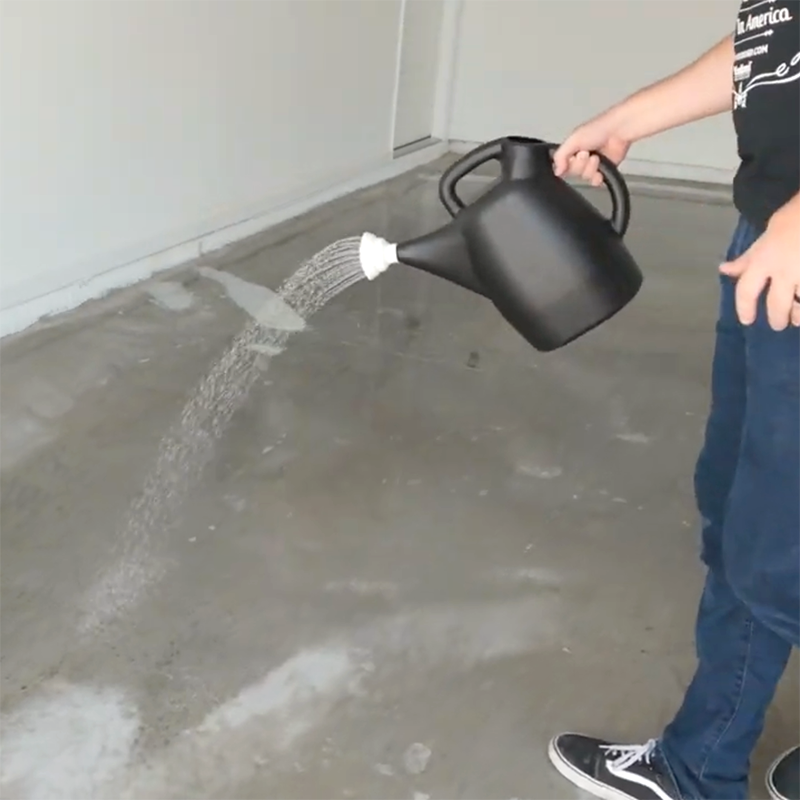
REQUIRED TOOLS: Scrub brush broom, plastic watering sprinkle can, garden hose or power washer, shop vacuum, squeegee, and proper PPE.
- Any surface that is about to be coated needs to be completely cured, clean and free of all contaminants.
- Apply our Concrete Cleaner, Degreaser & Etcher to remove dirt, oil, and contaminants.
- Sweep and vacuum the concrete surface to remove all loose debris. Thoroughly scrape and wipe away any grease or oil contamination. For heavier buildup, a power washer can be used to assist with deeper pre-cleaning.
- Mix 1/3 gallon (43 oz.) of concentrate with 1 gallon of water in a plastic watering sprinkle can. One gallon of concentrate will produce 4 gallons of premix. Hot water will accelerate cleaning and etching.
- Working in sections approximately 10' × 10' at a time, lightly dampen the concrete surface with a fine spray of water. Using a plastic watering sprinkle can, apply the premixed solution evenly across the concrete. Scrub the solution into the surface with a scrub brush broom, working it thoroughly until the foaming action stops. Rinse the area completely with a garden hose or power washer until all visible signs of cleaner have been removed.
- Use a squeegee or leaf blower to remove any standing water from corners, low spots, and out through the garage door, leaving the surface uniformly damp and ready for primer application.
-
Step 3: Mixing Area Setup
REQUIRED TOOLS: Mixing paddles, paint stir sticks, large tarp/drop cloth, or cardboard, shop towels, and proper PPE.
Set up a dedicated mixing area outside of your main application zone to prevent contamination and maintain a clean workflow. Choose a flat, well-ventilated space (typically in front of your garage) and place a 10'x12' protective drop cloth, plastic sheeting, or flattened cardboard on the ground to catch spills and drips. This barrier helps protect surrounding surfaces from epoxy splatter while giving you a controlled, organized station for accurate measuring and thorough mixing without disrupting your installation process.
-
Step 4: Masking The Area
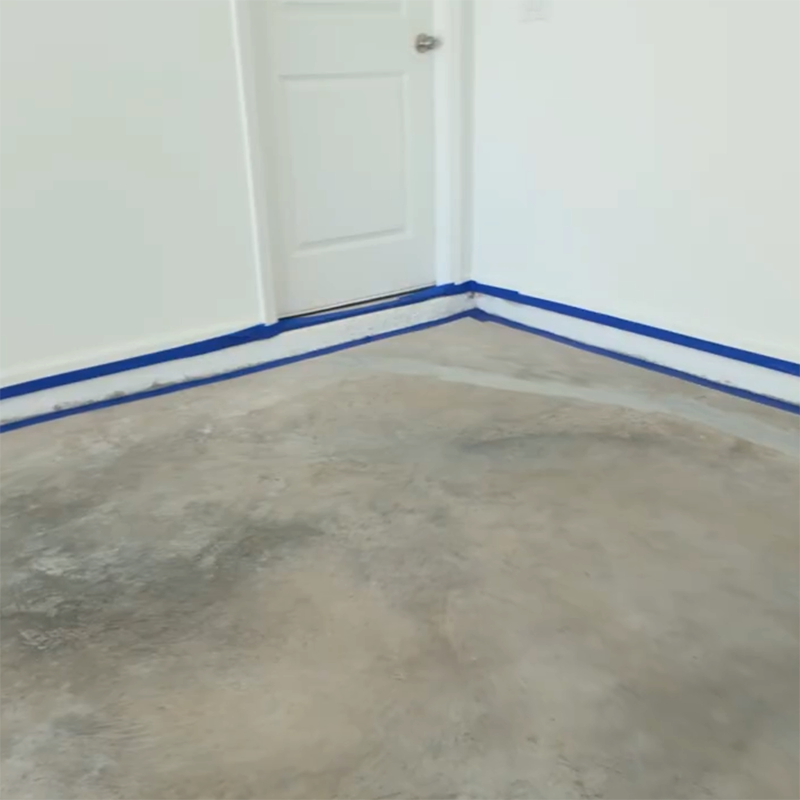
REQUIRED TOOLS: Blue painter's tape, and proper PPE.
Before applying any DIY coating, mask off all areas that should remain free of material, including unmovable freezers, water heaters, drains, door thresholds, or other adjacent objects.
If the garage stem walls/cove joints or the foundation block are already painted, mask along the perimeter where the wall meets the floor, leaving a 1/8" gap above the surface.
IMPORTANT: Make sure masking tape is firmly pressed onto the area to ensure correct adhesion so no product can seep or “bleed” underneath.
For application purposes, mark reference points the first 200 sq. ft. of the floor from the back wall to an expansion joint, if present.
IMPORTANT! Where the garage door
comes down to the floor, apply 1" of tape back and away from the bottom of the garage door where it meets the floor. This ensures the primer does NOT go past where the garage door comes down. Remove the tape after each product application accordingly.If the garage door floor area has a round over behind the door closed, mask off at the bottom of the round over onto the driveway surface. Remove the tape after each product application accordingly.
PULLING MASKING TAPE
Use spiked shoes to walk across quickly (but carefully) and pull the tape slowly from each end all the way across where it is taped. This ensures the tape doesn't become adhered to walls and objects when it dries/cures.
SkipGrind Primer – Pull tape during application rolling which will cover up any indents in the product left by the spiked shoes.
Epoxy & Flakes – Pull tape approximately 45 minutes to 1 hour after application, depending on temperature and curing
conditions.Polyaspartic – Pull tape approximately 45 minutes to 1 hour after application, depending on temperature and curing
conditions. -
Step 5: Stem Walls & Foundation Application: CoveCoat Primer
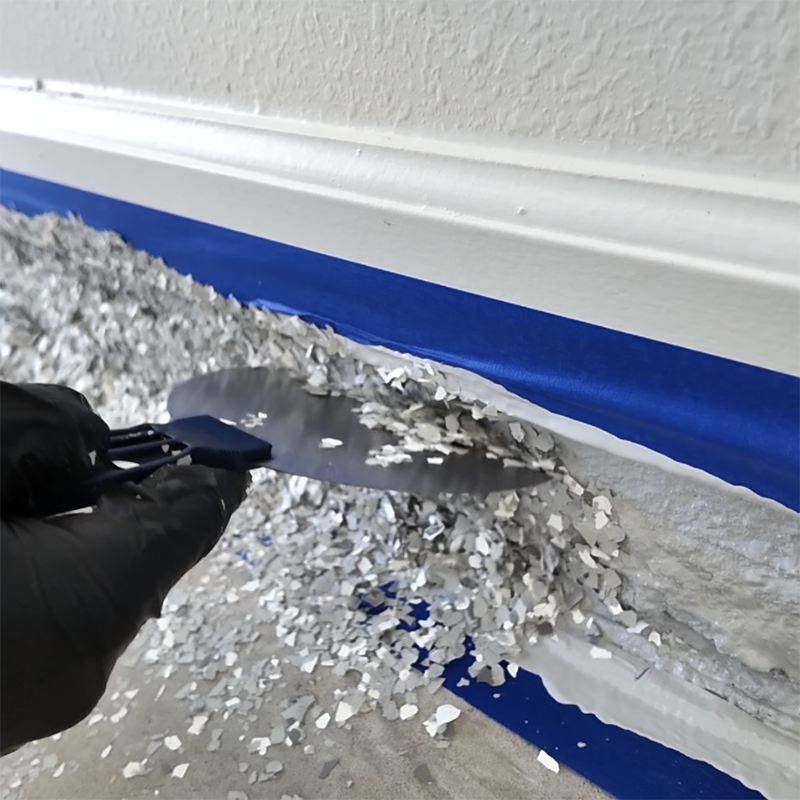
REQUIRED TOOLS: Stir stick, paint brush, 4-6" mini-roller & covers, utility knife, and proper PPE.
Make sure that temperatures will remain between 50- and 90-degrees Fahrenheit and relative humidity to stay below 75%.
IF APPLICABLE! Apply decorative 1/4" flake chips to coves, stem walls, stair risers, foundation walls, and other vertical concrete surfaces before any floor coating products are applied.
CoveCoat eliminates the need to use floor epoxy as an adhesive for decorative 1/4" flake chips on coves, stem walls, stair risers, foundation walls, and other vertical concrete surfaces. This easy-to-use, single-component coating provides exceptional adhesion, making it simple to achieve full flake coverage on vertical areas simple and effective.
- Stir CoveCoat thoroughly for 30-45 seconds prior to application. Working in 2-3 foot sections, apply CoveCoat evenly to the vertical surface using a brush or roller. Avoid excessive buildup, runs, or puddling.
- Immediately pour decorative 1/4" flake chips onto the floor directly in front of the freshly coated area.
- Using a wide putty knife, scoop the flakes upward onto the wet CoveCoat surface until complete cover-age is achieved. Tossing flakes by hand onto vertical surfaces typically will not provide full, uniform coverage.
- For stair steps and other horizontal surfaces, apply CoveCoat by brush or roller and broadcast decorative flakes to full coverage while the coating remains wet.
- After the flakes have cured to the CoveCoat for approximately 30-60 minutes, scrape the surface to remove any loose or protruding flake chips. Using a wide putty knife, scrape the surface to knock down high spots and create a more uniform profile before proceeding to later apply the polyaspartic.
Surface Preparation: Surfaces must be clean, dry, and free of dust, dirt, oil, grease, stains, silicone, or other contaminants that may interfere with adhesion.
- Working time: 2-5 minutes
- Dry time (walking): 30-60 mins
Clean Up: Thoroughly sweep and vacuum all loose and excess flakes from the floor surface before proceeding with the application of SkipGrind Primer.
-
Step 6: Masking the Area: SkipGrind Primer Application
REQUIRED TOOLS: Blue masking tape, utility knife, and proper PPE.
SkipGrind Primer is applied to the garage surface floor only. It does not need to be applied to stem walls or cove joints.
NOTE: Do not mix primer before completely masking off unmovable objects (water heater, A/C, etc.) and sections that need to be protected.
-
Step 7: Mixing SkipGrind Primer
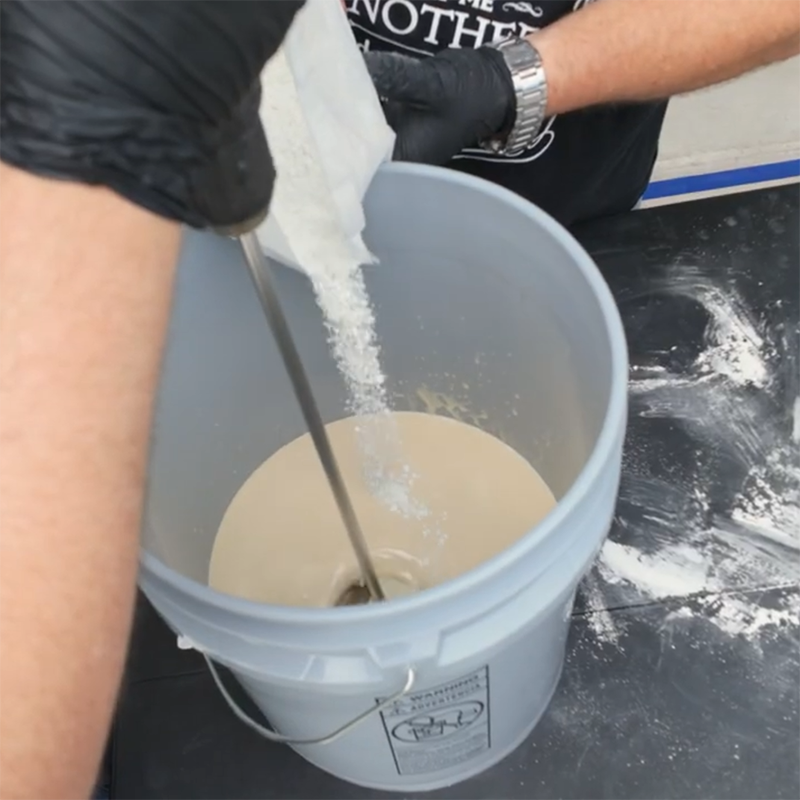
REQUIRED TOOLS: 5-gallon bucket, mixing paddles (Jiffy mixer), paint stir sticks, shop towels, face/dust mask and proper PPE.
- SkipGrind Primer kits are premeasured consisting of one jug of Part-A resin, one jug of Part-B hardener, and bags of Part-C thickening dry blend. NOTE: Part-C thickening blend is a dry powder and can easily form clumps if all three components are mixed together too quickly or inadequately. Incomplete mixing will cause an inconsistent finish. IMPORTANT!For best mixing results, pour Part-A resin and Part–B hardener into a 5-gallon mixing bucket and slowly blend in Part-C powder until fully dispersed and lump-free.It is important to “wet-out” all parts of dry mix, scraping the bottom and sides of bucket. Once the thickening dry blend Part-C has been completely incorporated, mechanically mix for approx. another 20 to 30 seconds.
- Mix the entire kit.
- After mixing, immediately pour onto concrete garage surface. Do not leave the mixed material in the bucket. This product is designed to be mixed and poured out in its entirety.
- NOTE: Hotter air temperature and higher humidity can reduce work-time.
-
Step 8: Apply SkipGrind Primer
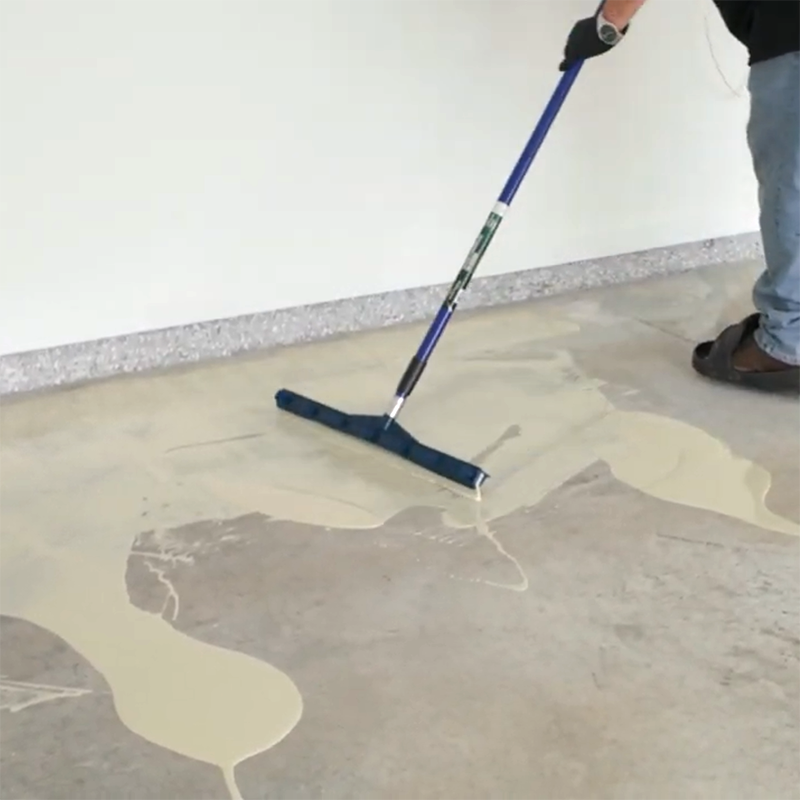
REQUIRED TOOLS: Spiked Shoes, notched blade squeegee, long handle 18" paint roller & covers, and proper PPE.
Make sure that temperatures will remain between 50- and 90-degrees Fahrenheit and relative humidity to stay below 75%.
NOTE: Apply SkipGrind Primer on a damp floor. It should be applied after the floor surface has been thoroughly cleaned, etched, and rinsed (Day 1 Prep). The garage floor should be damp but not wet. Use a squeegee or leaf blower to remove any standing water from corners, low spots, and out through the garage door, leaving the surface uniformly damp and ready for primer application.
- Immediately after mixing, pour the entire bucket evenly onto the concrete surface in wavy ribbons running perpendicular across the floor. Spread at approximately 100 sq. ft. per gallon (Each 2-gal/3-Part "kit" will cover 200 sq. ft.). Do not scrape the sides or the bottom of the mixing bucket onto the floor. Any unmixed product can contaminate the cure process.
- An easy application method is to work within the concrete control joint or expansion joint sections, spreading the primer with a squeegee and then back-rolling it smooth as you progress toward the garage door exit. Do not wear spiked shoes while walking on the SkipGrind Primer, as they can leave indentations or marks that may not self-level or heal during the curing process. Avoid filling and puddling in expansion joints. Clean out joints if needed.
- Use the 26" Easy Squeegee® Notched Blade, 15-20 Wft Mils gauge squeegee for proper thickness to spread the material.
- Next, using a 3/8” nap 18-inch non-shedding roller with a phenolic (plastic) core, roll the primer lightly forward and backward to distribute it evenly across the entire surface, do not cross roll. Roll just as you would paint a floor, ensuring uniform coverage working your way out of the room.
NOTES:
Do not tip the epoxy container upside-down on the floor. Any unmixed material can and will contaminate the cure process.
Remove tape: Masking tape must be removed before the primer begins to dry or cure. It is highly recommended to pull the tape up during application as you work your way toward the exit. Waiting until after complete application and walking back across the surface in spiked shoes will leave marks or indentations in the “SkipGrind Primer” that may not self-level or flow back smooth.
IMPORTANT: At the garage door threshold, where the floor meets the driveway and the 1" strip of painter's tape has been applied, do not remove the tape until the primer has become tacky. This allows the primer sufficient time to set and helps prevent it from flowing onto the protected area beneath the tape or beyond the edge onto the driveway, ensuring a clean, professional transition line. The tape can typically be removed approximately 45 minutes to 1 hour after application, depending on temperature and curing conditions.
- Working time: 15-20 minutes
- COVERAGE: 200 sq. ft. per "kit"
- Dry time (walking): 18 hours
- NOTE: SkipGrind must be allowed to cure a MINIMUM of 18 hours and completely tack free before coating with epoxy base-coat and broadcasting 1/4" flake chips.
Do not fully close the garage door during this curing window, as restricted airflow can impact performance and finish quality.
-
Step 9: Masking the Area: Epoxy & Flake Application
REQUIRED TOOLS: Blue masking tape, utility knife, and proper PPE.
Typically, stem walls/cove joints and the foundation block should be coated with epoxy and flakes. Tape off above that section to ensure clean, sharp lines for epoxy and flakes.
If the garage walls are already painted, apply blue painter’s tape along the perimeter where the wall meets the floor, leaving a 1/8" gap above the surface.
NOTE: Do not mix epoxy before completely masking off unmovable objects (water heater, A/C, etc.) and sections that need to be protected.
-
Step 10: Mixing Floor Base-Coat Epoxy
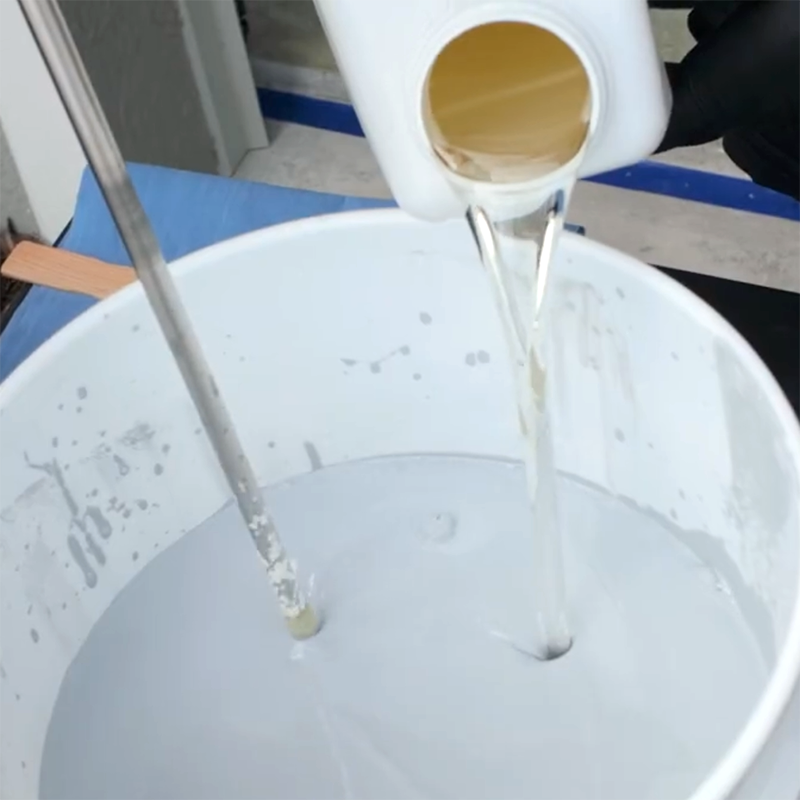
REQUIRED TOOLS: Mixing paddles (Jiffy mixer), paint stir sticks, shop towels, and proper PPE.
- Stir / Pre-mix the pre-tinted Part A for 20-30 seconds. Add the entire contents of Part B (1 part B to 2 parts A) into the Part A container, which is intentionally short-filled to achieve the correct ratio. Mix thoroughly for 90 seconds to 2 minutes. About halfway through the mixing process, scrape the sides and bottom of the container to ensure all material is fully incorporated and a complete, uniform blend is achieved.
- Mix the entire kit.
- After mixing, immediately pour onto concrete garage surface!
- NOTE: Hotter air temperature and higher humidity can reduce work-time.
-
Step 11: Apply Epoxy Base-Coat on Concrete Floor
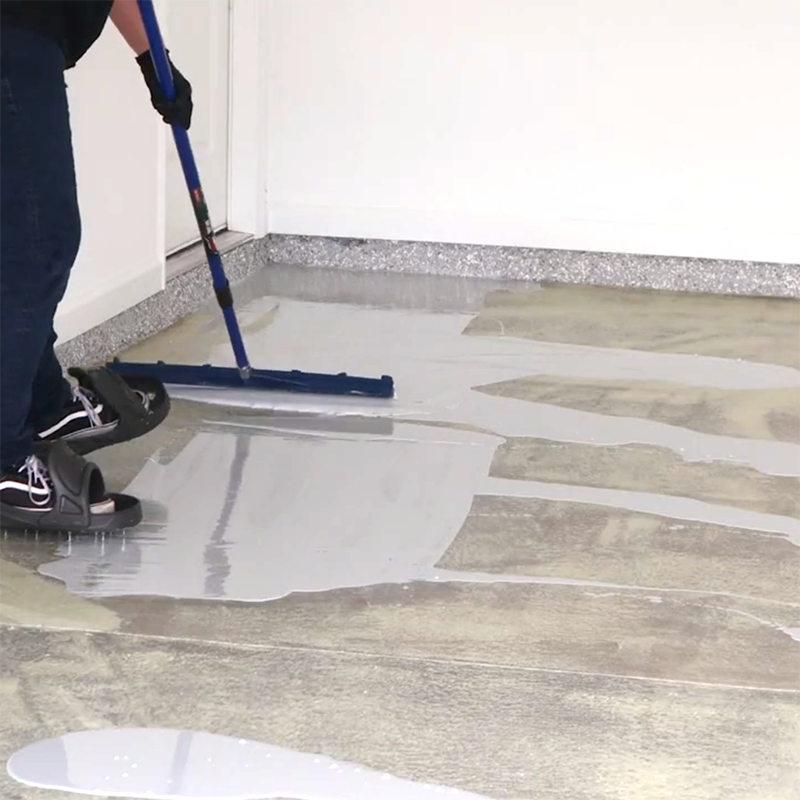
REQUIRED TOOLS: Spiked Shoes, flat blade squeegee, long handle paint roller & covers, and proper PPE.
Make sure that temperatures will remain between 50- and 90-degrees Fahrenheit and relative humidity to stay below 75%.
Stem walls/cove joints: If applicable, first with a paintbrush or small handheld roller, apply epoxy to the stem walls/cove joint concrete outer side walls of the room. Not all garage floors will have this or have it showing. This is also a good time to cut-in the edges of the floor against the wall and corners.
- While wearing spiked shoes, immediately pour the mixed epoxy onto the floor in wavy wide ribbons, running perpendicular across the surface. Do not scrape the sides or the bottom of the mixing bucket onto the floor. Any unmixed product can contaminate the cure process.
- An easy method is to apply within expansion joints. Avoid filling and puddling in expansion joints. Clean out joints if needed.
- Use the 26" Easy Squeegee™ with Flat Stiff Blade to evenly spread epoxy across floor surface at approx. 200 SF/Gal.
- Next, using a 3/8” nap 18-inch non-shedding roller with a phenolic (plastic) core, quickly roll the epoxy forward and backward to distribute it evenly across the entire surface. Apply just as you would paint a floor, ensuring uniform coverage working your way out of the room. Back roll in the opposite direction to level the coating IF NEEDED.
NOTES:
Be cautious to not leave roller lines or ridges which could show through as high points in the flakes.
Do not tip the epoxy container upside-down on the floor. Any unmixed material can and will contaminate the cure process.
- Working time: 30-40 minutes
- COVERAGE: 200-255 sq. ft. per gallon
- Flaked Surface Dry time (walking): typically 6-8 hours
Do not fully close the garage door during this curing window, as restricted airflow can impact performance and finish quality.
-
Step 12: Flake Broadcasting into Wet Epoxy
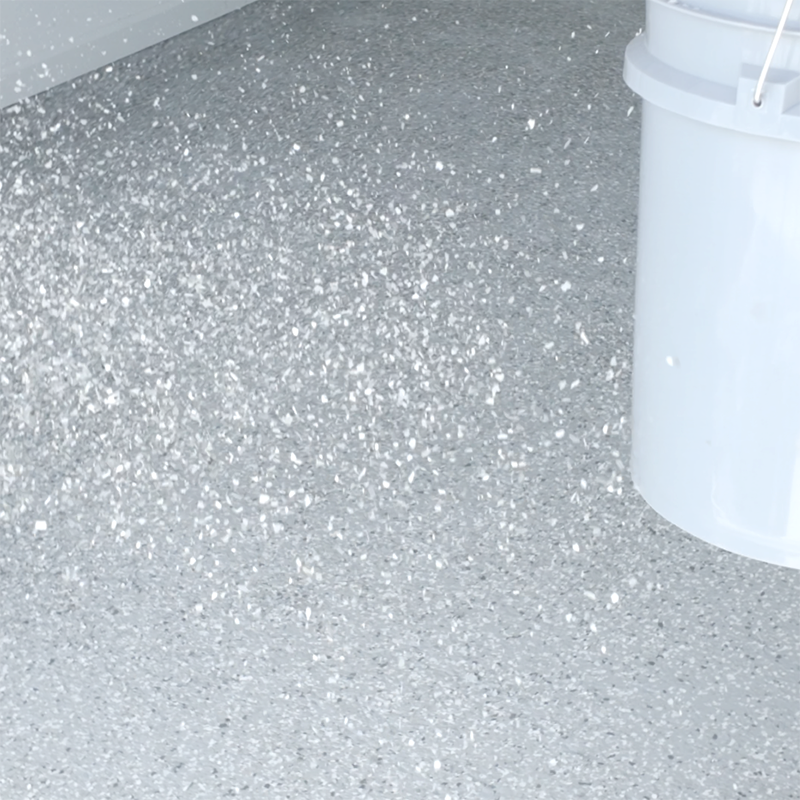
REQUIRED TOOLS: Spiked Shoes, 5-gallon bucket, and proper PPE.
- While the floor epoxy is still wet, broadcast the included box epoxy flakes onto the entire surface.
- (If applicable, first toss flakes onto the concrete stem wall block perimeter and/or cove joint side walls. Toss flakes onto the bottom side walls around the garage evenly.)
- While wearing spiked shoes, broadcast the 1/4" flake chips across the entire surface. For easier application, transfer flakes into a 5-gallon bucket and toss them upward, allowing them widely to fall evenly onto the floor. Apply flakes until the base coat epoxy is completely covered and no "wet" epoxy is visible. A properly broadcast floor will appear dry and uniform, with no shiny spots. If any epoxy is visible, continue applying flakes until complete coverage is achieved.
- Apply flakes using heaping handfuls, tossing them upward and outward into the air so they fall naturally onto the wet epoxy. Use a light flicking motion, similar to feeding chickens, to help the flakes disperse evenly. Be careful not to dump piles of flakes, this will look unnatural. Aim to broadcast 2–3 feet out in front of you, allowing for consistent, uniform coverage across the surface.
- You should see an even and dry coating of flake with no shiny spots/areas when properly covered. Add more flakes if you see shiny epoxy showing through.
- If the floor has low spots where the base coat is deeper, flakes may “sink.” Broadcast sufficient flakes to completely saturate the low spot. Continue tossing flakes moving around as you go, backing out towards your exit until the base-coat is 100% covered completely.
- Pay close attention to expansion control joints during the flake broadcast to ensure complete, uniform coverage. Flakes should be applied generously so no shiny base-coat epoxy remains visible, especially within and around the joints. It is normal for control joints to visually “disappear” during this stage due to full flake coverage.
Remove tape: Once the epoxy base-coat and flakes have been applied, the tape must be removed. This ensures the tape doesn't become adhered to walls and objects when it dries/cures. You will have around 45 minutes to maybe 1 hour to remove the tape. Use spiked shoes to walk across quickly (but carefully) and pull the tape slowly from each end all the way across where it is taped.
- Flake Coverage: One 25 lb. box of 1/4" decorative flake chips will typically cover 200–250 sq. ft. at full coverage (100% broadcast).
- Flaked Surface Dry time (walking): typically 6-8 hours
Do not fully close the garage door during this curing window, as restricted airflow can impact performance and finish quality.
-
Step 13: Remove Excess Flakes
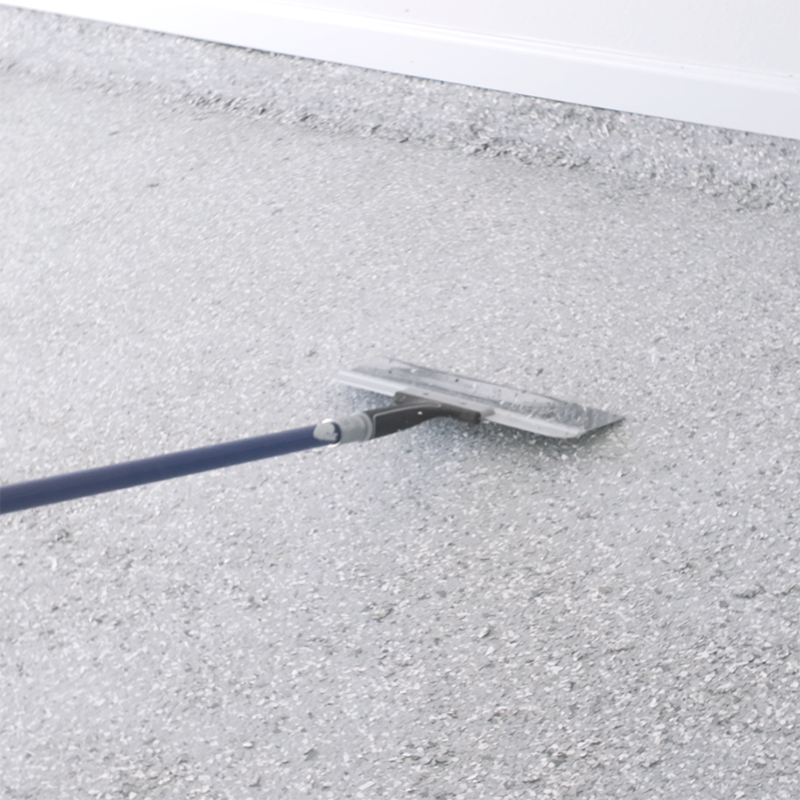
REQUIRED TOOLS: Flat blade scraper, broom, dustpan, shop vac, and proper PPE.
- Allow the flake broadcast garage floor to properly dry and cure. After 6-8 hours, remove excess flakes by scraping the surface with a flat-edge trowel or wide floor scraper (available on our website). This step knocks down sharp edges, vertical flake buildup, and any loose material to create a smooth, uniform profile.
- After the flake chips have been fully broadcast and cured, the expansion control joints must be reopened and cleaned out. Use a floor scraper or putty knife to carefully cut along the joint and remove any excess flakes or coating buildup.
- Don’t overlook the perimeter edges. Use a smaller scraper to remove excess flakes and buildup along base areas and lower wall edges. Finish by sweeping the surface with a stiff broom or leaf blower, then vacuum thoroughly to eliminate all remaining debris before applying the topcoat.
-
Step 14: Masking the Area: Polyaspartic Application
REQUIRED TOOLS: Blue masking tape, utility knife, and proper PPE.
Typically, stem walls/cove joints and the foundation block should be coated with epoxy and flakes. Tape off above that section to ensure clean, sharp lines for epoxy and flakes.
If the garage stem walls/cove joints or the foundation block are already painted, apply blue painter’s tape along the perimeter where the wall meets the floor, leaving a 1/8" gap above the surface.
NOTE: Do not mix Polyaspartic before completely masking off unmovable objects (water heater, A/C, etc.) and sections that need to be protected.
-
Step 15: Mix Polyaspartic Top-Coat
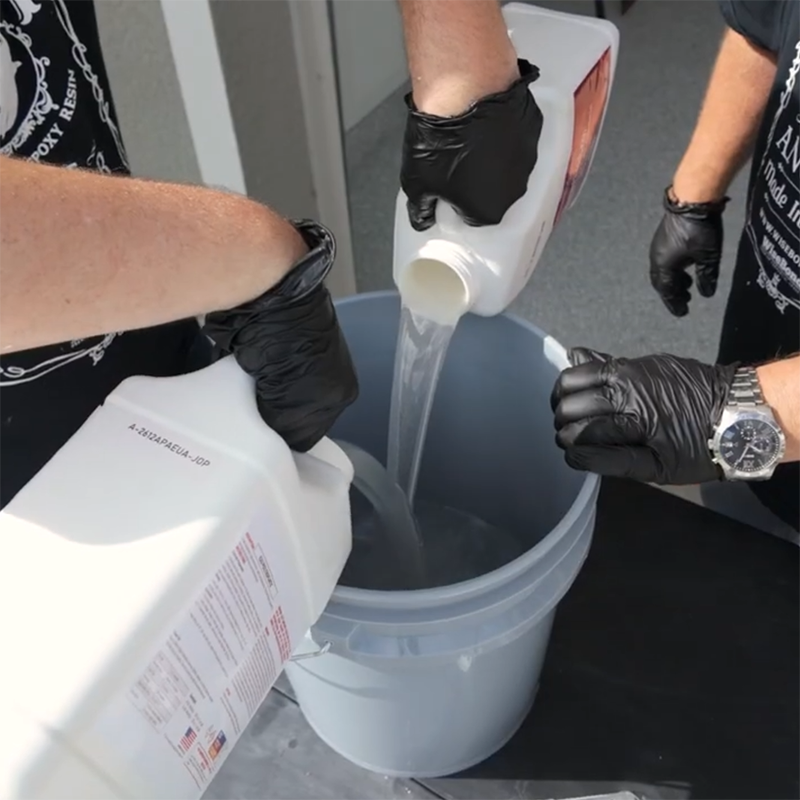
REQUIRED TOOLS: Mixing paddles (Jiffy mixer), paint stir sticks, shop towels, and proper PPE.
- Vigorously shake Part B for approximately 20 to 30 seconds. Pour Part-A and Part-B into a clean 5-gallon mixing bucket. Mix for 1 full minute using an electric drill at 500rpms, scraping the bottom and sides of the mixing container.
- If more than one 2-gallon kit is needed, do not mix more than can be applied within 25 minutes.
- Mix the entire kit.
- After mixing, immediately pour onto concrete garage surface!
- NOTE: Hotter air temperature and higher humidity can reduce work-time.
-
Step 16: Apply Polyaspartic Top-Coat Protection
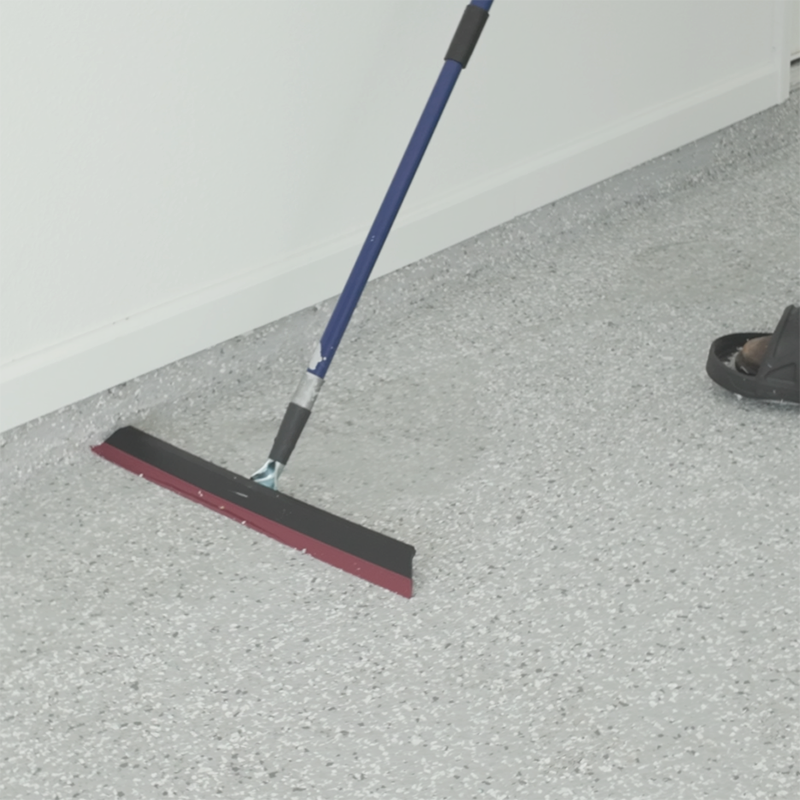
REQUIRED TOOLS: Spiked Shoes, flat blade squeegee, long handle paint roller & covers, mini-roller & covers, and proper PPE.
Make sure that temperatures will remain between 50- and 90-degrees Fahrenheit and relative humidity to stay below 75%.
- While wearing spiked shoes, immediately pour the mixed top-coat onto the floor in wavy wide ribbons, running perpendicular across the surface. Do not scrape the sides or the bottom of the mixing bucket onto the floor. Any unmixed product can contaminate the cure process.
- IMPORTANT / IF APPLICABLE: At the same time, pour approximately 48 oz. of the mixed polyaspartic into a paint tray. Using a mini roller, apply the polyaspartic to stem walls, stair risers, foundation walls, and any other vertical concrete surfaces. Complete these vertical areas while the floor coating remains wet to ensure a consistent finish and uniform appearance throughout the installation.
- Use the 27" Easy Squeegee™ Flat Flexible Blade with Corner Wings (fits the 26" frame) to evenly spread epoxy across the floor surface, which should cover 125-150 sq. ft. per gallon.
- Next, using a 3/8” nap 18-inch non-shedding roller with a phenolic (plastic) core, roll the top-coat forward and backward to distribute it evenly across the entire surface. Make sure to wet out your roller cover with excess material prior to rolling out the entire surface. Apply just as you would paint a floor, ensuring uniform coverage working your way out of the room. Back roll in the opposite direction to level the coating IF NEEDED.
NOTE: Be cautious to not leave roller lines or ridges which could show through as high points in the flakes.
Remove tape: Once the polyaspartic has been applied, the tape must be removed. This ensures the tape doesn't become adhered to walls and objects when it dries/cures. You will have around 45 minutes to maybe 1 hour to remove the tape. Use spiked shoes to walk across quickly (but carefully) and pull the tape slowly from each end all the way across where it is taped.
- Pot life: 5 minutes
- Working time: 25 minutes
- COVERAGE: 125-150 sq. ft. per gallon
- Dry time (walking): 12 hours
- Dry time (return of contents): 24-48 hours
- Cure / return to service: 72 hours+ (driving)
Do not fully close the garage door during this curing window, as restricted airflow can impact performance and finish quality.
Installation Questions
Quick answers to the most common questions about installing your WiseBond flake floor.
Do I really not need to grind my concrete first?
Correct. The WiseBond SkipGrind Primer eliminates the need for mechanical concrete surface grinding. It bonds to virtually any properly cleaned, etched, and damp surface, creating a strong adhesion layer without the dust, noise, and labor of traditional prep.
How long does the install take from start to drive-on?
The hands-on work happens across one weekend, but full cure to vehicle traffic takes a minimum of 72+ hours after the topcoat. Light walking is allowed roughly 10–12 hours after the topcoat; return contents after 24 hours; drive on after the full cure.
Why can't I fully close the garage door during cure?
Each coating cures with airflow. Restricted ventilation can affect performance and finish quality, so leave the door open a 6–8 inch gap during dry and cure windows.
Do I need two people to install it?
It's strongly recommended. One person mixes and pours while the other immediately spreads the materials. That timing keeps each coat consistent and within its working window.
What temperature and humidity do I need?
Apply with ambient and surface temperatures above 50°F (10°C) and below 90°F (32°C), with relative humidity below 75%, and conditions that stay in range for at least 24 hours after application.
How do I handle expansion control joints?
Keep epoxy and flake out of standing pools in the joints during application, then re-open and clean the joints after the flake cures. See the full control-joint guide.
Ready to Start Your Weekend Build?
Pick your color, size your kit, and get everything you need in one box; primer, epoxy, flake, and polyaspartic topcoat.